Author Diversity
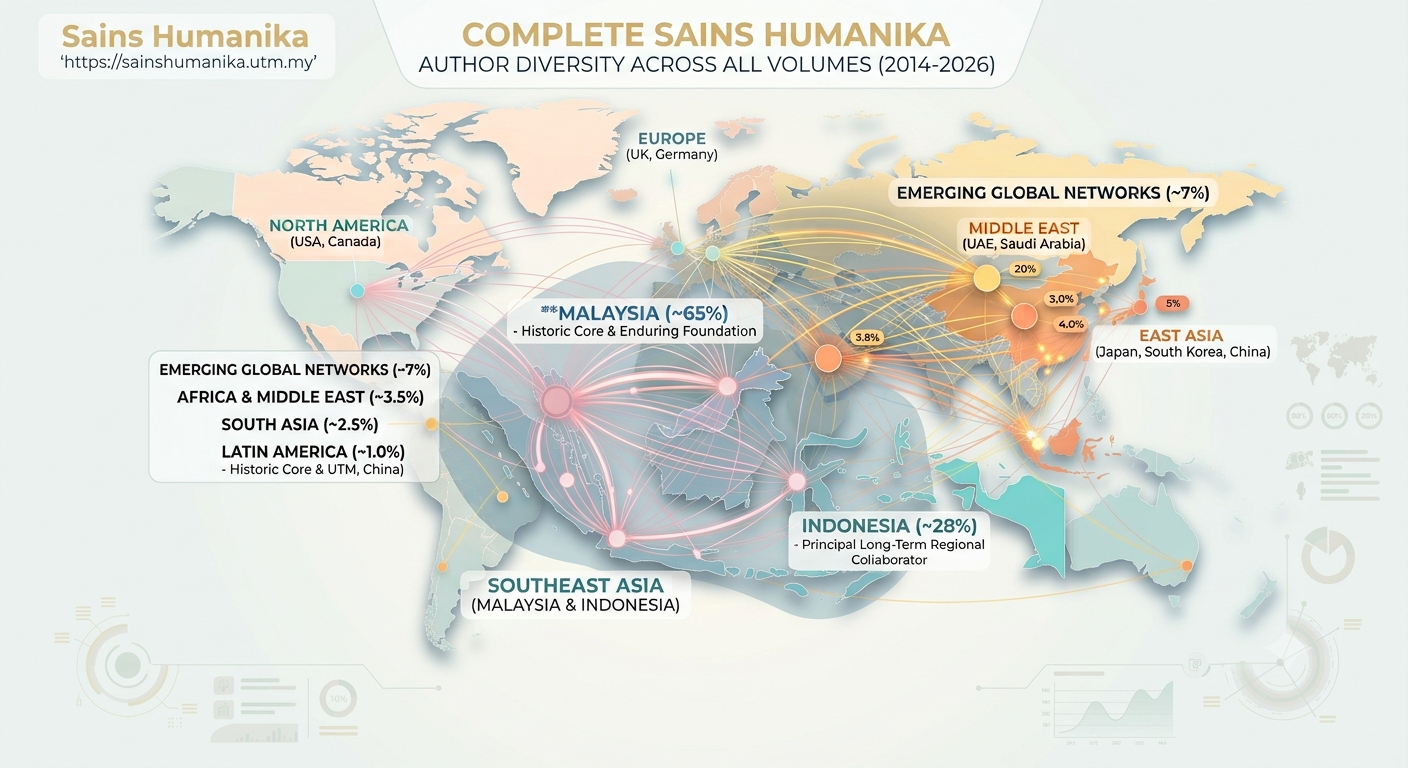
1. Malaysia (The Domestic Anchor: 65%)
As an open-access journal published by Universiti Teknologi Malaysia (UTM) Press—which was recently recognized at the prestigious Malaysia Scopus Research Star Awards—Sains Humanika serves as a primary vehicle for local scholarship.
-
Institutional Concentration: While anchored by UTM researchers, a high volume of contributions comes from other top-tier Malaysian institutions, such as Sultan Idris Education University (UPSI), Universiti Malaya (UM), and Universiti Kebangsaan Malaysia (UKM).
-
Language Dualism: The journal allows submissions in both English and Bahasa Melayu. The ~76% domestic block heavily utilizes the Bahasa Melayu track for localized social issues, national curriculum studies, Islamic education models, and native psychological frameworks that are highly relevant to local policy but less suited for western-centric journals.
2. Indonesia (The Regional Partner: 28%)
Indonesia constitutes the journal's largest and most consistent international pipeline. In recent issues (such as the Vol 18 issues), multiple collaborative papers feature co-authors split between Malaysian and Indonesian institutions.
-
Linguistic Alignment: Because Bahasa Indonesia and Bahasa Melayu share deep linguistic roots, Indonesian academics easily navigate the journal’s bilingual ecosystem.
-
Shared Cross-Border Contexts: Much of the research centers on socio-cultural frameworks, Islamic education, and community management structures that apply equally to both Sumatra/Java and Peninsular/Borneo Malaysia.
3. Global & Emerging Partners (7%)
The remaining slice of the author map represents the journal’s growing push toward broader internationalization to maintain its Scopus status.
-
The Middle East Hub: Pockets of authors appear from countries like the United Arab Emirates (UAE) and Saudi Arabia, typically driving research forward in Islamic banking, digital media adoption, and cross-cultural communication.
-
East Asia: Scholars from Japan and South Korea make up minor percentages, frequently collaborating with Malaysian co-authors on specialized areas like technical education (e.g., Flipped STEM learning frameworks) and industrial workplace psychology.